The Attention Economy Has a Design Problem

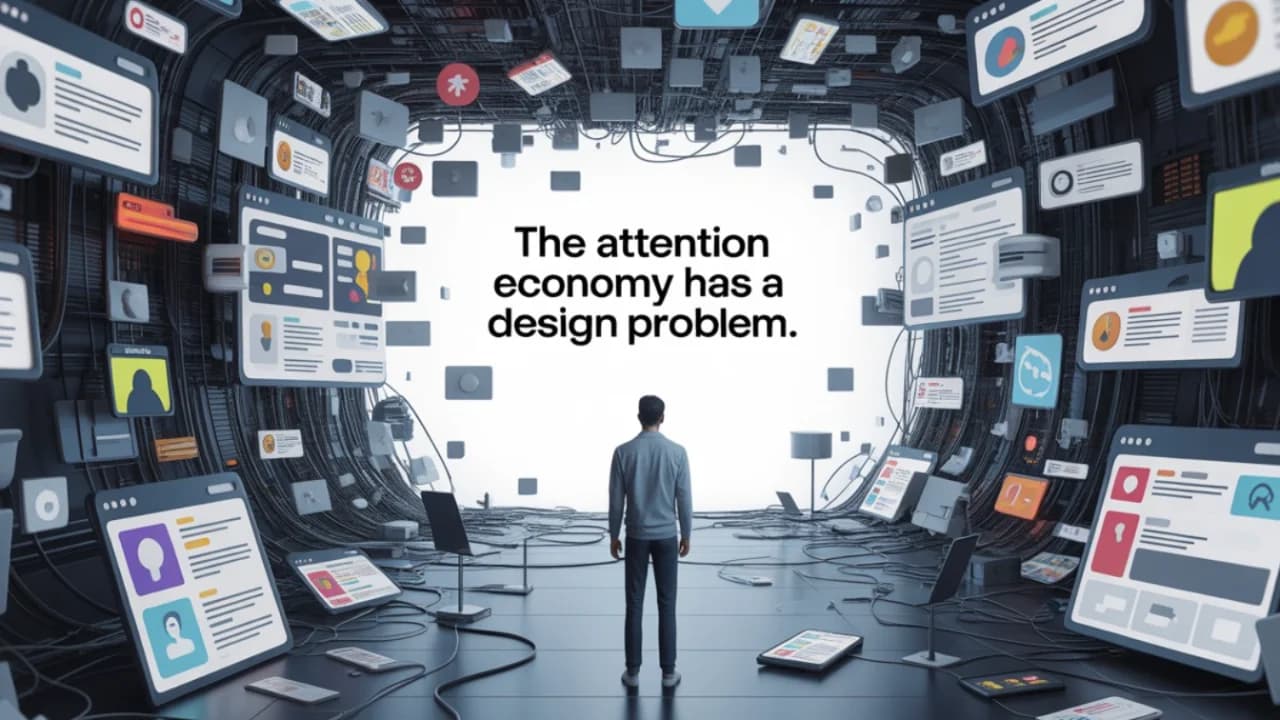
For the past decade, the digital economy has been built on a simple assumption: attention is the most valuable resource on the internet.
That assumption is not wrong. But it has produced the wrong incentives.
When attention becomes the primary metric, products start optimizing for capture before they optimize for value. Feeds never seem to stop, and notifications are engineered to bring us back almost automatically. The result is a digital culture that is incredibly sophisticated at acquiring attention, and often surprisingly weak at deserving it. DataReportal Deloitte
The scale of this competition is extraordinary. As of early 2025, there were 5.24 billion active social media user identities globally, and the typical internet user was spending 2 hours and 21 minutes a day on social media. The average person was also active across 6.83 platforms each month. Our attention isn’t in one place anymore. It’s scattered across a bunch of different platforms, all trying to grab as much of it as they can. DataReportal
At the same time, the commercial pressure to win that competition is intensifying. Deloitte points to a media landscape in which digital video ad spend is growing nearly 80% faster than the media market overall, while social platforms, creators, streamers, and legacy media companies increasingly compete inside the same recommendation-driven environment. In practical terms, everyone is now in the same business: trying to win the next second of someone’s attention. Deloitte
What gets lost in this model is the human cost. Research discussed by psychologist Gloria Mark through the American Psychological Association found that the average amount of time people spend on one screen before switching has fallen from about 2.5 minutes in 2004 to roughly 47 seconds in recent years, with a median of 40 seconds. Her work also links frequent attention switching with higher stress, greater cognitive effort, and more errors. That is an important distinction. The issue is not simply that people are distracted. It is that many of the systems around us have been designed to normalize distraction as a business model. American Psychological Association
Even seemingly minor interruptions matter more than we tend to admit. Research published in PubMed Central found that smartphone notifications can reduce sustained attention and slow responses even when people are not actively using their devices. The broader literature cited in that study also connects heavy smartphone use and media multitasking with weaker distractor filtering and lower sustained attention. In other words, the attention economy does not just consume time. Over time, it can reshape the quality of attention itself. PMC (PubMed Central)
That is why I think the next chapter of the attention economy will not be defined by who captures attention most aggressively. It will be defined by who creates experiences that feel worth attending to.

Not all attention is equal. There is a meaningful difference between attention that is extracted and attention that is invested. One leaves people depleted. The other can leave them challenged, connected, entertained, and even enriched. The products that will matter most over the next decade are not the ones that simply maximize time spent. They are the ones that make time spent feel justified.
This is where interactive entertainment becomes more important than many people realize. At its best, gaming offers a very different contract with attention. It asks for participation rather than passive consumption. It creates goals instead of loops, agency instead of drift, progress instead of repetition. It can be social, competitive, expressive, and immersive all at once. In a digital environment dominated by endless scroll, that difference matters.
There is another principle that matters too: relevance. People do not just pay attention to what is novel. They pay attention to what feels close to them, socially, culturally, geographically, emotionally. Research from the Reuters Institute found that people are drawn to stories they see as personally relevant and helpful for connecting with others. Related findings highlighted by the Local News Lab showed that local news was perceived as more noteworthy than national news, with respondents rating an average of 43% of local news as relevant or interesting. In a crowded digital market, proximity still has power. Reuters Institute Local News Lab
That belief has shaped how we think about Exscape.
From the beginning, our view has been that digital attention should lead somewhere better than passive consumption. It should lead to play, participation, connection, identity, and reward. That is why Exscape has been built as more than a single entertainment feature. It brings together games, social spaces, challenges, virtual environments, mazes, and rewards into one connected experience. The point is not to keep people busy for as long as possible. The point is to give them something more intentional to do with their time.
That philosophy shows up in practical ways. Games ask for skill and action rather than passive scrolling. Social features create shared experiences rather than isolated consumption. Challenges and leaderboards give structure and progression. Rewards create a clearer exchange of value. And the emphasis on local communities and culturally resonant digital spaces reflects a simple truth: people engage more deeply when an experience feels relevant to who they are and where they are. Exscape
None of this is a claim that technology should demand less ambition. If anything, it should demand more. We should expect digital products to be more imaginative, more responsible, and more valuable in the way they compete for our attention. The future should not belong to the platforms that win by reducing human focus into a series of reflexes. It should belong to the ones that turn attention into something more active, more social, and more meaningful.
That, to me, is the real opportunity in front of the industry. Not escaping the attention economy but improving its terms.
Because in the end, the most enduring products will not be the ones that are best at taking attention. They will be the ones that give people a reason to feel their attention was well spent.
We believe all digital products should be designed to respect people’s attention and make it feel worthwhile, and Exscape is one example of that approach.